

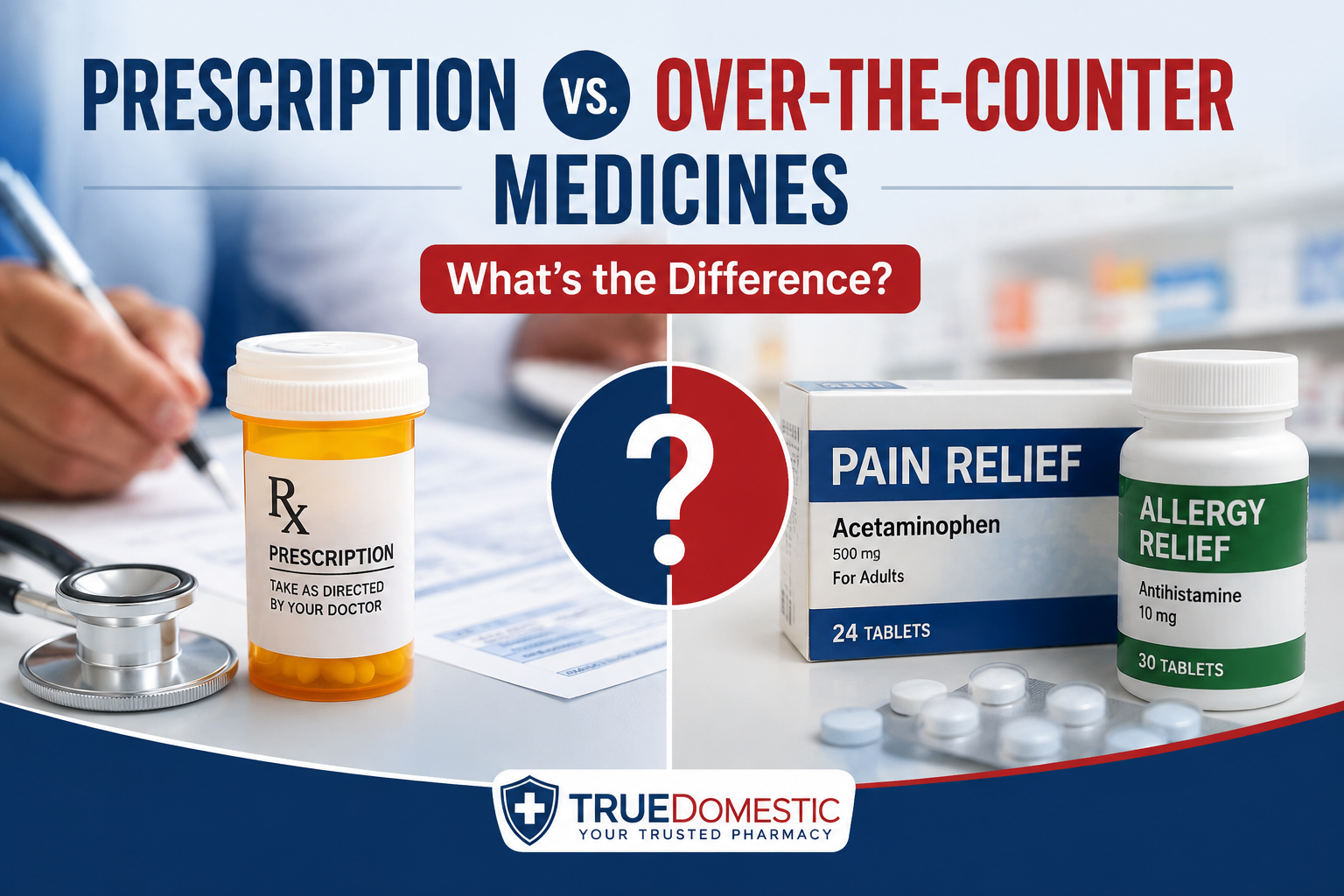
Prescription vs. Over-the-Counter Medicines: What’s the Difference?
Medicines are an important part of healthcare, but not all medicines are obtained or used in the same way. Some medicines require a prescription from a qualified healthcare professional, while others can be purchased without a prescription.
Understanding the difference between prescription medicines and over-the-counter (OTC) medicines can help you make more informed and responsible decisions about medication use.
What Are Prescription Medicines?
Prescription medicines are medications that require authorization from a qualified healthcare professional before they can be dispensed.
These medicines may require professional supervision because they can have significant effects on the body, may cause side effects, or may require careful dosage and monitoring.
A healthcare professional may consider factors such as:
- Your symptoms and medical condition
- Medical history
- Age and other individual factors
- Other medicines you are taking
- Possible drug interactions
- Appropriate dosage and treatment duration
Prescription medicines should only be used by the person for whom they were prescribed and according to the provided instructions.
What Are Over-the-Counter Medicines?
Over-the-counter medicines, commonly called OTC medicines, are products that can generally be purchased without a prescription.
They are commonly used for minor or short-term health concerns, depending on local regulations. Examples may include products used for occasional headaches, minor aches and pains, allergies, heartburn, or common cold symptoms.
Although OTC medicines are available without a prescription, that does not mean they are completely risk-free.
They still have recommended doses, warnings, possible side effects, and potential interactions with other medicines.
Key Differences Between Prescription and OTC Medicines
The main difference is whether a prescription or healthcare professional’s authorization is required.
| Prescription Medicines | OTC Medicines |
|---|---|
| Usually require a prescription | Generally available without a prescription |
| Often used for conditions requiring professional assessment | Commonly used for minor or short-term symptoms |
| May require medical monitoring | Usually designed for responsible self-use when used according to the label |
| May have more significant risks or interactions | Can still cause side effects and interactions |
| Dosage is often individualized | Directions are generally provided on the product label |
Regulations can vary from one country to another, so a medicine’s classification may not be the same everywhere.
Are OTC Medicines Completely Safe?
No. “Over-the-counter” does not mean “risk-free.”
Taking too much of an OTC medicine, combining products with the same active ingredient, or using a medicine despite a relevant medical condition can cause problems.
For example, someone taking multiple cold or pain-relief products should check their active ingredients to avoid accidentally taking overlapping ingredients.
Always read the label and follow the recommended dosage.
Why Are Some Medicines Prescription-Only?
Some medicines require professional oversight because of factors such as:
- Potential for serious side effects
- Risk of interactions with other medicines
- Need for individualized dosing
- Potential for misuse or dependence
- Requirement for medical monitoring
- The need to confirm a diagnosis before treatment
A healthcare professional can determine whether a particular medicine is appropriate and explain how it should be used.
Can Prescription Medicines Be Used Without a Prescription?
Prescription medicines should not be used simply because they worked for someone else or because similar symptoms are present.
Two people with the same symptom may have completely different underlying conditions. A medicine that is appropriate for one person may be unsuitable for another.
Using someone else’s prescription medicine can also increase the risk of side effects, interactions, incorrect dosing, or delayed diagnosis.
Can OTC Medicines Interact With Prescription Medicines?
Yes. OTC medicines can interact with prescription medicines, supplements, or other products.
This is why it is important to tell your doctor or pharmacist about everything you are taking, including:
- Prescription medicines
- OTC medicines
- Vitamins
- Herbal products
- Dietary supplements
If you are starting a new OTC medicine while already taking prescription medication, ask a pharmacist or doctor whether it is appropriate for you.
When Should You Speak With a Healthcare Professional?
Consider contacting a doctor or pharmacist if:
- Your symptoms are severe or persistent.
- You are unsure which medicine is appropriate.
- You take multiple medicines.
- You have an existing medical condition.
- You are pregnant or breastfeeding.
- You experience an unexpected reaction.
- You are unsure about the correct dosage.
- An OTC medicine does not improve your symptoms as expected.
Professional guidance can help prevent unnecessary medication risks.
Tips for Safer Medication Use
Whether a medicine is prescription or OTC, responsible use is important.
Always:
- Read the label and instructions carefully.
- Check the active ingredients and strength.
- Follow the recommended dosage.
- Do not share prescription medicines.
- Check for possible interactions.
- Store medicines according to the instructions.
- Keep medicines away from children.
- Check expiry dates before use.
- Ask a pharmacist if you are unsure about a medicine.
Final Thoughts
The key difference between prescription and OTC medicines is how they are authorized and accessed, but both types require responsible use.
Prescription medicines generally require professional evaluation and oversight, while OTC medicines are intended for appropriate self-care when used according to their instructions.
If you are uncertain about which medicine to use, how much to take, or whether it can interact with another product, speak with a qualified doctor or pharmacist.
Medical Disclaimer: This article is intended for general educational purposes only and does not replace professional medical advice, diagnosis, or treatment. Medication availability, classification, and dispensing requirements can vary by country and region. Always follow the instructions on the product label and seek guidance from a qualified healthcare professional when needed.